Pricing
Ragextract uses prepaid credits which bills you only on execution costs allowing for greater visibility and control of your budget.
All prices exclude VAT and sales tax. Where it applies, it is added at checkout at the rate for your location.
We are not currently able to sell credits to consumers in the EU — see our Credits Policy.
2,000 free trial credits when you sign up, until 29 December 2026 — terms apply
What credits are spent on.
Two things are charged: reading a document, and answering a question about it.
- Uploading a document, file or ImageCharged once and covers the processing, retrieval embeddings and storage. Every table you later build on it reads the same indexed pages.1 creditPage or Image
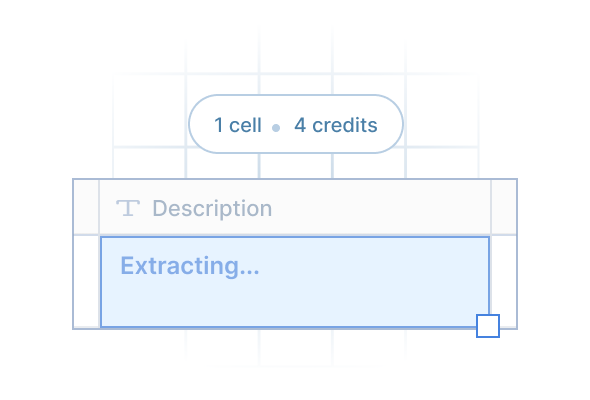
- Answering a questionSearch, extraction and AI calls to answer a cell. A cell is one row × one column. Certain columns types costs more.4–12 creditsCell
- GDrive, Sharepoint & MailhookNo hidden addon costs or monthly maintenance contracts. Just add your credentials and go!Free
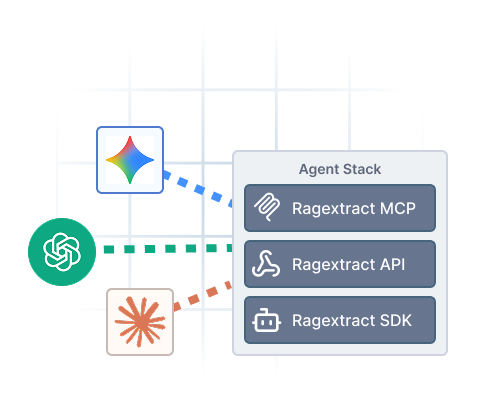
- API, MCP and Agent SkillsLet us become part of your daily AI toolkit! Everything you'd expect from a modern platform.Free
- Seats, workspaces and storageNo abritrary limits to constantly be reminded of. Contact us if you need scale.Free

Put your own numbers in.
Start from a month’s worth of work or size a one-off project.
| Steady | Volume | Credits |
|---|---|---|
| Upload | 4,500 pages | 4,500 |
| Extraction | 2,000 cells | 12,000 |
| Total Credits | 16,500 |
The presets describe documents arriving over a month and the questions asked of them — a document already in the workspace is never read, or charged, a second time. Figures are an estimate at the published rates: list columns are priced at the top of their range and grouped rows on the dearer of the two engine paths, so a real bill should land at or under this, and the app quotes the exact cost of a run before you start it. Every figure the calculator shows excludes VAT and sales tax, which is added at checkout where it applies.
Buy more, pay less per credit.
The bonus applies to the whole amount, so spending more is never worse per credit.
| Top-up (excl. VAT) | Bonus | Credits | Effective |
|---|---|---|---|
| $10 | — | 4,000 | $0.002500 |
| $20 | +5% | 8,400 | $0.002381 |
| $50 | +10% | 22,000 | $0.002273 |
| $200 | +15% | 92,000 | $0.002174 |
| $500 | +20% | 240,000 | $0.002083 |
Top-up amounts and effective rates both exclude VAT and sales tax; where it applies, it is added at checkout on top of the amount shown, and the credits you receive are unaffected by it. Credits expire 12 months from purchase and purchases are final. If a job fails, the credits it consumed come back. Read the credits policy.
Questions about the bill.
How buying works, and what the tables above do not say.
Do I pay per user, or per workspace?
Neither. Seats, workspaces and storage are not charged for, and there is no subscription and no minimum term. You buy credits, and credits are spent on work the service actually does — reading a page, answering a cell, and searching your documents from a connected application or the API.
What is the smallest amount I can buy?
$10, which buys 4,000 credits at the standard rate. There is no monthly commitment and nothing renews on its own — when a balance runs low you buy more, or you do not.
Can I see what a run will cost before it runs?
Yes. Every screen that starts charged work quotes it first — "about N credits" — and names the shortfall if your balance will not cover it. The quote is an upper bound, so a run usually costs the same or less.
If I buy a lot at once, will I lose what I do not use?
Credits expire twelve months from the date of purchase, and they are spent oldest first, so an earlier purchase is always used before a later one expires. Buying in the amount you expect to use within a year is the way to avoid it.
Do larger purchases cost less per credit?
Yes. Bonus credits are added on the whole amount, starting at $20 and rising in four steps to the top band at $500. The table above shows what each amount buys and what that works out to per credit.
If I add a column next year, do I pay to read the documents again?
No. Reading a document is charged once, when it is uploaded, and every table built on it afterwards reads the pages that were already indexed. A new column is charged for the cells it answers and nothing else.
Why did one row cost more than the others?
It was probably a bundle — several documents answering as a single row. The first three documents in a bundle are included in the column’s rate, and each one past the third adds to that cell’s cost, because each document is read separately.
Am I charged when a job fails?
If we charged you for work we did not deliver, we put the credits back. That is a service remedy in credits rather than a cash refund, and it is the remedy the credits policy sets out.
What happens if I run out of credits?
Nothing is lost. Cells that could not run are marked "Out of credits" rather than failed, and buying more re-arms the rows that never started. Only an empty balance stops anything: a run that is merely short of funds still goes ahead, because the quote is an upper bound rather than a reservation.
Do the free credits I get at sign-up work the same way?
Not in every respect. They are credits and they buy the same work, but they expire on a different clock from credits you buy, they earn no bonus, and they do not count towards anything that depends on what you have spent. The credits policy sets out the differences in full.

Size it against your own documents.
Signing up comes with 2,000 free credits — enough to read 2,000 pages. No card, no subscription.